
The Critical Role of Response Protocols in Managing Adverse Events
Capturing an incident, complaint, or maintenance glitch is only half the battle. When an adverse event occurs, the critical question is not just who ...
Product Update : Improved system menu management - Learn More

Artificial intelligence is dominating conversations across every industry. But for organisations operating in healthcare, disability, aged care, and community services, the conversation around AI cannot just be about what is possible - it must be about what is safe, compliant, and governed.
In highly regulated environments, generic, black-box AI tools pose significant risks around data privacy, data sovereignty, and accuracy.
At Logiqc, we believe that AI should not replace human judgment, nor should it introduce administrative risk. Instead, it should act as an accelerator—reducing friction for busy staff while strengthening the robust quality and risk frameworks leadership teams rely on.


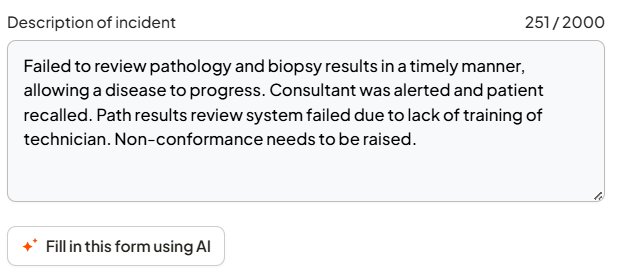
Incident reporting is essential to safety and continuous improvement, yet filling out detailed forms in busy, high-demand service environments takes time. Our first AI-driven feature, Logiqc AI Incident Report, directly addresses this challenge by giving frontline workers a faster starting point for structured reporting.
How it works:
Plain Language to Structured Data: Staff can describe an incident in plain language, on web or mobile. Logiqc AI analyzes the description and suggests accurate values for supported incident-report fields.
No Guesswork: If the provided details are unclear or incomplete, the AI will not guess. The fields remain blank for the user to complete manually.
Human-in-the-Loop: AI-populated fields are clearly identified and fully editable. Before a report can be submitted, the user must explicitly confirm they have reviewed the information, keeping human oversight firmly at the center.
By easing the reporting burden at the point of entry, organizations capture better, more timely data—leading to stronger trend analysis, risk management, and clinical governance.
Introducing AI into your quality management system requires uncompromising standards. We designed the architecture of Logiqc AI with strict enterprise guardrails to ensure it aligns perfectly with the compliance expectations you already bring to our platform.
Total Administrative Oversight
AI credit usage should never be hidden or unpredictable. Administrators have complete visibility through a dedicated dashboard tracking monthly AI credits, usage over time, and activity by user—giving your organisation complete management over its digital footprint.
AI security
Logiqc currently uses GPT-4o-mini which Microsoft does not make available as local deployment type. This means that the actual location of inference (where the prompt is processed by AI models) is done within Microsoft's global ecosystem. All data at rest is stored strictly in Australia.
When using our AI feature, only the data strictly necessary to generate the requested response is transmitted to the Azure OpenAI Service for processing (inference). This includes:
Form Content & Inputs: Text entered into form fields, selected dropdown values, category selections, and specific configuration settings (such as Severity settings).
Data Handling, Privacy, and Storage Boundaries
Prompts are not de-identified, pseudonymised, masked, or redacted. Additionally, any supporting select fields with dynamic content is also sent as readable text for the purposes of inference. Prompts are discarded after this use and files uploaded or attached to an incident report are not submitted to OpenAI for inference.
Inference (Transient Processing): Transmitted data is processed in-memory solely to generate the response. It is discarded immediately after the inference request is completed.
No Model Training: Customer data submitted via Azure OpenAI is not used to train, retrain, or improve Microsoft’s foundational models or any third-party models.
Data Residency at Rest: Generated AI outputs and system records stored at rest remain located strictly within Microsoft Azure data centres in Australia.
Abuse Monitoring: Transferred data is processed in accordance with Azure OpenAI enterprise security standards. Access to any temporary monitoring logs is strictly controlled by Microsoft security operations under regulated compliance frameworks, ensuring customer data remains isolated and protected.
Looking Ahead: The Future of Logiqc AI
The launch of AI Incident Reporting is just the beginning. As we continue to develop the Logiqc AI ecosystem, our focus will remain anchored to the same core principles: reducing administrative friction, maintaining absolute data privacy, and keeping humans in control.
Request a free, personalised demo to see how Logiqc can benefit your organisation



All Rights Reserved © Logiqc - ABN 79 120 710 769
Privacy Policy